
The Papers
Understanding the Nature of Humanity
An Anthropological Framework for Christian Doctrine
Rev. Greg Warnock · 2026 edition · 64 pages · eight figures
3.1 MB · 64 pages · typeset for letter-size print, with glossary, bibliography and index. Opens in your reader; save it from there.
Abstract
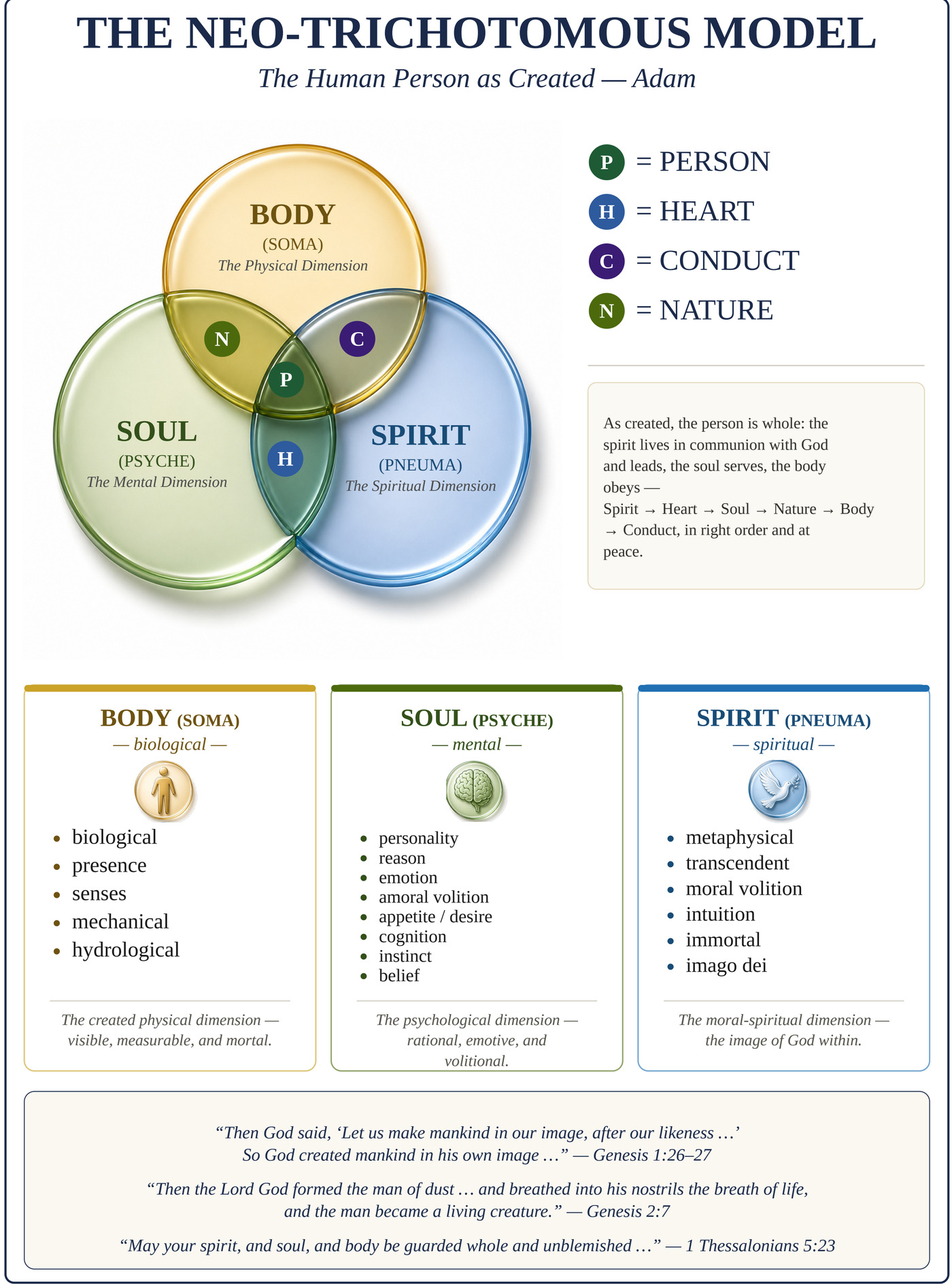
Christian anthropology has long been contested between multiple theoretical models including dichotomous models, which hold that the human person consists of body and soul, and classical trichotomous models, which add the term spirit but, in their most influential form, treat it as the rational mind. This paper advances a novel position, the Neo-Trichotomy model, first presented in 1987 and revised here. It retains the biblical vocabulary of body, soul, and spirit while redefining the latter two: the soul carries the rational, emotive, and amoral choice faculties shared in some measure with higher animals, and the spirit carries moral volition, intuition, and the created image of God (Imago Dei).
The redefinition is prompted in part by research in animal cognition, which increasingly suggests that reason, emotion, and elective behavior are less uniquely human than earlier models assumed. If those faculties do not distinguish humanity, the divine image must be located elsewhere.
The paper tests the model across the arc of Christian doctrine — the image of God, the fall and sin, redemption, and sanctification and the fruit of the Spirit, then the person and work of Christ in the Incarnation, the Cross, and the Resurrection, closing with the Trinity and the love of God — and argues that it illustrates each more coherently than the two models it questions: the classical trichotomy, which, in the form that equates the spirit with the rational mind, collapses when applied to Christ into the ancient Apollinarian heresy; and the traditional dichotomy, which treats the person as body and soul, the single immaterial part divided into a base and a higher nature. Its sharpest claim concerns the Incarnation: because the human spirit is a created gift, breathed in by God rather than arising from the flesh, Christ may be held fully human and fully divine without diminution of either, His full humanity recognized as created body and soul inherited through the Virgin Mary, and in the line of David, while His spirit was never created. His spirit is God.
One methodological commitment runs through all of this. Where most anthropologies aim chiefly to describe what a human being is, this model is concerned as much with how redemption moves through what a human being is — treating the person not as a static structure but as the arena in which grace does its work, one dimension at a time. The anthropology is the tool; the gospel is the point.
How to use this paper
This paper is the foundation beneath a set of teaching resources, not a standalone tract. It is not intended to be the first thing placed in a seeker’s hands. Its purpose is to establish — for the teacher, pastor, or ministry leader — that the model on which those resources rest is theologically sound.
The companion materials (teaching guides, workbooks, conversational aids, and field cards) are built for practical use and can be given directly to students and disciples. This document exists so that those who teach from them may do so with confidence, knowing the framework has been thought through and can bear the weight placed upon it.
Provenance
This study grows from a thesis I wrote as a young student under Arthur O. Roberts (1923–2016) — my professor and mentor at George Fox College, for many decades the chair of its department of religious studies. I was privileged to serve as his research and teaching assistant from 1983 to 1987, in Religion, Philosophy, and Ethics, and I was a recipient of his uncommon generosity: he entrusted me with his own classes while I was still an undergraduate. He once remarked that some of my conclusions were “novel and deserve serious consideration.” I offer it in that spirit — not as a novelty of doctrine, but as an effort to see an old confession more clearly.
Contents
- 1.Introduction — why Neo-Trichotomy; body, soul and spirit explained; the model in the wider conversation
Part One — The Human Person
- 2.The Image of God: Humanity’s Unique Identity
- 3.Sin: A Christian Understanding Through the Neo-Trichotomy Lens
- 4.Redemption: Restoring Harmony Through the Neo-Trichotomy Lens
- 5.The Fruit of the Spirit: Transformation Through the Neo-Trichotomy Lens
- 6.Sanctification: Growing in Christlikeness Through Spirit-Led Transformation
Part Two — God’s Answer
- 7.The Model and the Creeds
- 8.The Incarnation: Fully God and Fully Human
- 9.The Cross: The Severed Spirit Healed
- 10.The Resurrection: Death Undone and the New Humanity
- 11.The Trinity: One God in Three Persons
- 12.The God Who Is Love
- 13.Limitations of the Model
- 14.Summary
- Glossary of Key Terms · Bibliography · Index
Figures
- 1.The human person as created — Adam
- 2.Sin located in the spirit
- 3.The believer
- 4.The Maturing Christian
- 5.The effect of sanctification
- 6.The order of divine influence and human response
- 7.The Incarnation
- 8.The Flow of Life in Christ
Understanding the Nature of Humanity: An Anthropological Framework for Christian Doctrine · 2026 edition · about 24,000 words · licence and permissions
© 2026 Greg Warnock. Licensed under Creative Commons Attribution–NoDerivatives 4.0 International (CC BY-ND 4.0). You may copy, print and redistribute it in any medium, for any purpose, provided you give credit and do not distribute modified material.
Translation into any language is permitted under a separate standing grant. Current terms and the signed grant.
Scripture quotations at Genesis 2:7, Psalm 51:10, Hebrews 4:12 and 1 Thessalonians 5:23 are the author’s own translation from the Hebrew and Greek. All others are taken from the English Standard Version, used by permission; those quotations are not covered by the licence above. Anyone reproducing or translating the complete work must obtain permission from the Bible-text copyright holder or substitute a text they are licensed to use.
Reprint enquiries: permissions@warnockcommons.org