
Broadside No. 3
The Great Commission and Cultural Arguments
We are not necessarily faithless. We are often under-formed.
Greg Warnock · Salem, Oregon · 16 October 2026
The Great Commission sends us to make disciples. Too often, we neglect the Gospel message of hope and redemption with arguments over politics, loyalties, and how other people should live.
My criticisms aim at patterns in American Christianity, not at individual denominations or congregations. Together they raise questions the Church should not avoid.
Today’s essay checks those patterns from several angles: doctrine, discipleship, a changing culture, the generations, maturity, and the distance between what we know, believe and how we live. I may develop some of these into essays of their own. First, I want them seen together, as parts of a larger concern.
I wonder sometimes whether the 21st Century Church in America has become so occupied with arguing political, social and cultural causes that we’ve forgotten to share the Gospel.
We have become remarkably proficient at taking sides. On politics, sexuality, immigration, nationalism, education, war, poverty, cultural identity, and ten thousand other issues, Christians seem expected to have a position, preferably a forceful one.
And often, we do.
Ask us why we hold those positions, however, and surprisingly the answers can become doctrinally thin.
Ask whether and how those convictions arise from the nature of God, the teachings of Jesus, or a coherent understanding of Scripture, and we may discover that what we call Christian conviction is sometimes little more than cultural loyalty dressed in religious language.
We know which side we’re on.
I’m less certain we always know why.
Peter urged the early Church to honor Christ, “always being prepared to make a defense to anyone who asks you for a reason for the hope that is in you; yet do it with gentleness and respect” (1 Peter 3:15).
The defense he had in mind was a reason for our hope, not a cultural argument.
Why Historical Doctrine Matters
One of the great neglects of contemporary American Christianity is the erosion of serious doctrinal discipleship.
We’ve become quite good at attracting people to church, inviting them into worship, and offering programs for almost every stage of life. Yet I wonder how consistently we’ve taught them to understand the faith they profess.
Not merely to memorize John 3:16, or repeat a denominational statement of belief, but to understand the relationships between Scripture, theology, human nature, redemption, grace, and the life we’re called to live.
Christian doctrine is not simply a collection of ancient theological arguments, preserved for scholars and pastors to debate. It is the accumulated work of generations of believers seeking to understand what Scripture teaches about the nature of God, the nature of humanity, the person and purpose of Jesus Christ, and what those truths mean for the way we live.
The creeds name them plainly:
- Scripture: God has spoken, and the Bible is His Word.
- God: one God in three persons, Father, Son, and Holy Spirit.
- Creation: God made all things, and made them good.
- Humanity: made in God’s image, body, soul, and spirit.
- Sin: the fall, and its reach into every part of us.
- Christ: fully God and fully human, His life, death, and resurrection.
- The Holy Spirit: God present and at work in the believer and the Church.
- Salvation: grace, faith, forgiveness, and new life.
- Sanctification: being made holy, the lifelong work of becoming like Christ.
- The Church: the Body of Christ, its worship, sacraments, and mission.
- Last Things: Christ’s return, resurrection, judgment, and the new creation.
Historical Christian doctrine gives us a foundation from which to understand our faith with confidence. It teaches us not merely what Christians have believed, but why those beliefs matter—and how they should shape our character, our relationships, and our responsibilities toward others.
Without that foundation, we risk producing sincere but spiritually immature Christians. People who know the language of faith but lack the theological understanding to apply it consistently.
And nowhere is that immaturity more apparent than in the arguments Christians have with one another—and with the world—about politics, social responsibility, cultural values, and moral conduct.
We can become passionate defenders of positions we have never learned to examine through the nature and purposes of God. We may know what our church believes about an issue without understanding how that conviction should be expressed through the love Christ demonstrated.
How can we expect Christians to apply the teachings of Jesus thoughtfully and confidently to the controversies of our time if we have not adequately taught them the historical doctrines that illuminate the nature of God, the nature of humanity, the purpose of Christ, and the meaning of redemption?
We cannot reasonably expect mature Christian wisdom from people who have never been given the theological foundation upon which that wisdom should rest.
Properly discipled Christians need not become less passionate about their convictions. Rather, they should become better equipped to understand, examine, explain, and advocate for them.
Grounded in an understanding of biblical principles and the nature and purposes of God, Christians can engage the controversies of their time without allowing cultural pressures, popular opinion, or persuasive personalities to determine their convictions.
Orthodoxy should inform what we believe. Discipleship should transform how we live. And the love of Christ should be evident in both.
The Gospel in a Changing World
For roughly two thousand years, the Church has carried the same Gospel through an astonishing variety of cultures.
The first Christians met in homes, broke bread together, and read the apostles’ letters aloud to one another (Acts 2:46; Colossians 4:16). Later believers gathered in basilicas and cathedrals, in camp meetings and storefront churches, and now, often, on screens. The ways Christians worship, gather, communicate, educate, organize congregations, and take part in public life have changed again and again. First-century worship looks very little like a contemporary American congregation’s worship today, and much of what was customary five hundred, two hundred, or even one hundred years ago would feel foreign to us now.
The Gospel did not change with them.
Historical orthodoxy, then, is not the preservation of an earlier century’s cultural forms. It is the faithful transmission of what God has revealed, through whatever forms each century provides.
Imagine the Church a thousand years from now.
Perhaps Christians will gather on another planet. Perhaps they will communicate through technologies we cannot yet imagine. Their families, societies, institutions, and forms of worship may bear little resemblance to ours.
What will their churches look like? What moral questions will confront them? How will they understand their responsibilities toward one another?
And which of our present arguments will they recognize as expressions of enduring Christian doctrine, rather than the cultural concerns of our particular century?
The question is not whether Christianity can survive cultural change. It already has.
The question is whether we understand our faith well enough to distinguish what must endure from what may legitimately change.
A good place to begin is with a word we use but often misunderstand.
In much of contemporary American life, “evangelical” has come to describe a political and social identity as much as a theological one, and usually a conservative one. Many evangelical Christians hold those convictions sincerely and advocate for them in good conscience, as citizens should. But the association has blurred a distinction the Church cannot afford to lose.
- Evangelism: proclaiming the Good News of Jesus Christ.
- The Great Commission: Christ’s command to make disciples of all nations through proclamation, baptism, teaching, and continuing discipleship.
- Political or cultural identity: a set of social commitments Christians may hold and advocate for, but which is not the same thing as evangelism.
Evangelism is not a political perspective on Christianity. It is the proclamation of Jesus Christ.
The Great Commission carries that proclamation into the continuing work of making disciples, teaching them to follow Jesus across nations, cultures, and generations.
Evangelism is not the defense of a particular Christian culture. It is the proclamation of Christ across every culture.
Return for a moment to that Church a thousand years from now. Christians on another planet should not be required to adopt the political institutions, cultural loyalties, or worship practices of twenty-first-century American Christianity to receive the Gospel.
Neither should our neighbors today.
Paul put it this way: “I have become all things to all people, that by all means I might save some” (1 Corinthians 9:22). Yet the same apostle warned that no one, not even “an angel from heaven,” could preach a different gospel (Galatians 1:8).
God’s nature and the Gospel remain constant. Cultures, institutions, methods of communication, and expressions of worship change.
Our understanding and application of doctrine may also deepen, and at times it has required correction. But cultural change alone does not determine theological truth. Scripture remains the measure.
This is where doctrinal competency proves its worth. Christians who know only the forms of their own century can defend those forms, but they cannot carry the faith beyond them. Christians who understand the doctrine beneath the forms can carry what must endure into cultures they have never seen, and explain it to generations they will never meet.
A Faith We Make Up as We Go
When that understanding is neglected, we don’t necessarily abandon Christianity.
We begin making it up as we go.
When that happens, Christianity becomes something like a ChatGPT conversation without reliable sources: an answer generated from whatever information happens to be available, presented with remarkable confidence, whether or not it is true.
A sermon here. A political commentator there. A favorite Christian personality, a viral video, a persuasive friend, or an emotional response to whatever controversy dominates the week.
We collect convictions without necessarily developing a theology capable of supporting them.
And when the cultural winds change, we change with them—or dig in our heels, mistaking stubbornness for faithfulness.
Neither response is particularly reassuring.
Paul’s warning to the Ephesians addresses precisely this kind of instability. After describing the Church as a body equipped by Christ through apostles, prophets, evangelists, pastors, and teachers, Paul says that believers are meant to grow into maturity rather than remain spiritually vulnerable. They are not to be “children, tossed to and fro by the waves and carried about by every wind of doctrine, by human cunning, by craftiness in deceitful schemes” (Ephesians 4:11–14). The image is not merely of people who hold incorrect opinions; it is of immature believers who can be manipulated because they lack the grounding to test what they hear.
Nearly two thousand years later, the warning remains remarkably contemporary.
The Inheritance We Pass Along
Perhaps some of this is generational.
I write to my generation, and to all the generations that follow. I’ve lived long enough to watch the Church navigate enormous cultural changes, from the institutions and traditions that shaped my early understanding of Christianity to a world where information, opinion, and religious authority compete for our attention every hour of the day.
My generation inherited a Church that often assumed attendance was discipleship.
Many of us were taught to show up, behave properly, respect authority, and avoid asking too many questions. We learned the language of Christianity, but not always the architecture beneath it. We were given conclusions without always being taught how those conclusions were formed. And what we failed to understand fully, we could hardly expect to pass along faithfully.
Then American culture changed.
The institutions we trusted became less trustworthy. The authorities we were told to respect contradicted one another. The Church became increasingly entangled with political identity. And the digital world gave everyone a platform, whether or not anyone had developed the wisdom to use it.
So we adapted.
We learned to distrust institutions without learning how to evaluate the information and ideas that rushed in to fill the gap. We questioned authority yet sometimes replaced it with persuasive personalities who spoke confidently into our fears. We resisted being controlled, only to become vulnerable to algorithms designed to keep us angry, afraid, and engaged.
And therein lies one of the great ironies across generations: we have encouraged people to think for themselves without adequately teaching them how to think theologically—or to consider the consequences of their convictions and decisions.
We challenged inherited assumptions without always distinguishing necessary corrections from destructive rejection. We learned to survive cultural change, but not necessarily to interpret it through the Gospel. And too often, we failed to consider what we might lose in rejecting what previous generations had entrusted to us.
Now we find ourselves in a Church where many possess strong opinions but lack the theological foundations necessary to examine them.
We are not necessarily faithless.
We are often under-formed.
That distinction matters.
A generation can be sincere and still be confused. It can have the courage to challenge what it inherited without the wisdom to discern what deserves to be preserved. It can be deeply committed to truth and still mistake emotional certainty for spiritual maturity.
The answer is not to romanticize the past or condemn the present. It is to recover the work of formation that many of us never received.
The Lukewarm Church May Be Closer Than We Think
In Revelation 3:14–22, the risen Christ addresses the church at Laodicea with a devastating assessment: it is neither cold nor hot, but lukewarm.
The familiar passage is often used to challenge Christians who seem insufficiently enthusiastic about their faith. Yet Christ’s words address something more serious than a lack of religious excitement. The Laodicean church believed itself to be rich, prosperous, and in need of nothing, while Christ declared that it was wretched, pitiable, poor, blind, and naked. Its problem was not simply weak emotion; it was self-satisfied spiritual blindness.
That is the more sobering diagnosis.
A church can be busy, influential, financially successful, politically engaged, and absolutely convinced of its own righteousness while remaining spiritually impoverished.
It can defend Christian values without consistently demonstrating Christian love.
It can win arguments while losing people.
And perhaps most dangerously, it can become so certain of its own cultural importance that it no longer recognizes the voice of the One it claims to represent.
The image with which Christ closes His message to Laodicea is especially troubling. He stands at the door and knocks, inviting anyone who hears His voice to open it (Revelation 3:20).
It is difficult to imagine a more provocative picture of a spiritually self-satisfied church: Christ calling for a response from the very people who profess to belong to Him.
I don’t believe the solution is a louder Church.
I believe it is a better-grounded one.
A Church that understands what it believes, why it believes it, and how those beliefs should shape its conduct toward every human being—including those who reject its teachings.
Especially those people.
The Greatest of These Is Love
Paul’s famous declaration in 1 Corinthians 13 is so familiar that we risk treating it as decoration.
We print it on wedding programs. We frame it on walls. We read it at celebrations of affection and commitment.
Yet Paul was addressing a divided Christian community, one struggling with spiritual pride, competing loyalties, and the misuse of religious gifts. In the preceding chapters, he had explained that the Corinthians’ different gifts were meant to serve one body, not establish a hierarchy of spiritual importance. Chapter 13 therefore functions as the necessary center of his argument: gifts, knowledge, faith, sacrifice, and religious achievement have no lasting value when separated from love.
His argument was not sentimental.
It was corrective.
Paul concludes that faith, hope, and love remain, “but the greatest of these is love” (1 Corinthians 13:13). He does not mean that truth or faith is unimportant. He means that love is the quality that gives Christian knowledge, faith, service, and endurance their proper purpose and character.
Not because truth doesn’t matter.
Not because doctrine is optional.
Not because moral distinctions disappear in the presence of compassion.
But because love is inseparable from the nature of the God whose truth we claim to defend.
John makes that connection explicit in the context of Christian fellowship and mutual love: “Anyone who does not love does not know God, because God is love” (1 John 4:8). John is not offering a slogan detached from conduct. He is arguing that love for fellow believers reveals whether a person truly knows God, because the God revealed in Christ is the source and pattern of such love.
This is not merely a description of something God does. It is a declaration about who God is.
If our theology cannot be expressed through love, we should ask whether we have understood it.
If our convictions require contempt for those who disagree, we should examine the convictions—or at least the spirit in which we hold them.
And if our defense of Christianity makes Jesus increasingly difficult to recognize, something has gone terribly wrong.
Even the Most Egregious Sinner
Here is where I expect some readers will become uncomfortable.
God’s love is not reserved for people who behave properly.
It is not earned through doctrinal accuracy, moral achievement, political agreement, or religious respectability.
Christ did not wait for humanity to become worthy before demonstrating the love of God.
In Romans 5, Paul develops this point by contrasting human love, which is rarely offered for the undeserving, with God’s action toward sinners. He writes that “while we were still sinners, Christ died for us” (Romans 5:8). The surrounding argument makes clear that Christ’s death was not a reward for prior moral improvement; it was God’s demonstration of love toward people who were still alienated from Him.
That includes the people whose behavior we find reprehensible.
It includes those whose beliefs offend us, whose lifestyles challenge our convictions, whose politics anger us, and whose sins we find almost impossible to understand.
It includes people who have done terrible things.
And, rather inconveniently, it includes us.
To say that God loves the sinner is not to suggest that God approves of every human action. Nor does love eliminate accountability, justice, repentance, or the obligation to protect people from harm.
Love is not moral indifference.
But neither is moral conviction permission to withhold the dignity and compassion owed to another human being.
Jesus left no room for doubt on this point: “Love your enemies and pray for those who persecute you, so that you may be sons of your Father who is in heaven. For he makes his sun rise on the evil and on the good, and sends rain on the just and on the unjust” (Matthew 5:44–45).
Jesus did not make His love conditional upon a person’s prior agreement with His teachings. The Gospels repeatedly show Him receiving, healing, confronting, and calling people whose lives were morally or socially disordered. He invited Himself into the home of Zacchaeus, a tax collector, before Zacchaeus had promised to repay anyone (Luke 19:1–10). He ate at Levi’s table with tax collectors and sinners, and when the religious leaders objected, He answered, “I came not to call the righteous, but sinners” (Mark 2:17). His welcome was not an endorsement of every action; it was the beginning of an encounter in which grace and truth could meet.
He encountered people where they were, without pretending they were necessarily where they ought to be.
He offered grace without abandoning truth; John describes Him as “full of grace and truth” (John 1:14).
Why do we so often behave as though we must choose between them?
Doctrine Is Not the Enemy of Love
I have spent much of my life thinking, writing, and sometimes arguing about theology, and I’ve published papers addressing some of these very concerns.
One of those papers, Understanding the Nature of Humanity: An Anthropological Framework for Christian Doctrine, proposes a model of human nature that examines the relationships between body, soul, and spirit, and the regions where these dimensions overlap and interact.
At first glance, that may seem like a subject far removed from the Church’s public arguments. It is not.
The question of what a human being is lies beneath nearly every Christian conviction about how human beings should live. Before we can speak responsibly about moral action, discipleship, responsibility, freedom, sin, grace, or sanctification, we must have some account of the person who is acting, believing, desiring, and being transformed.
My paper therefore explores a foundational question: How does our understanding of body, soul, and spirit help explain what God accomplishes in us through redemption and sanctification—and how that transformation becomes visible in the way we live?
Within this framework, three overlapping regions help explain the relationships between our spiritual, psychological, and physical realities:
- Heart (soul and spirit): where spiritual moral leading engages thought, emotion, memory, and natural will.
- Nature (body and soul): the creaturely processes through which we perceive, respond, choose, and act.
- Conduct (body and spirit): moral direction expressed visibly through embodied life.
These are not separate components of the human person, but regions of interaction within the larger model of body, soul, and spirit.
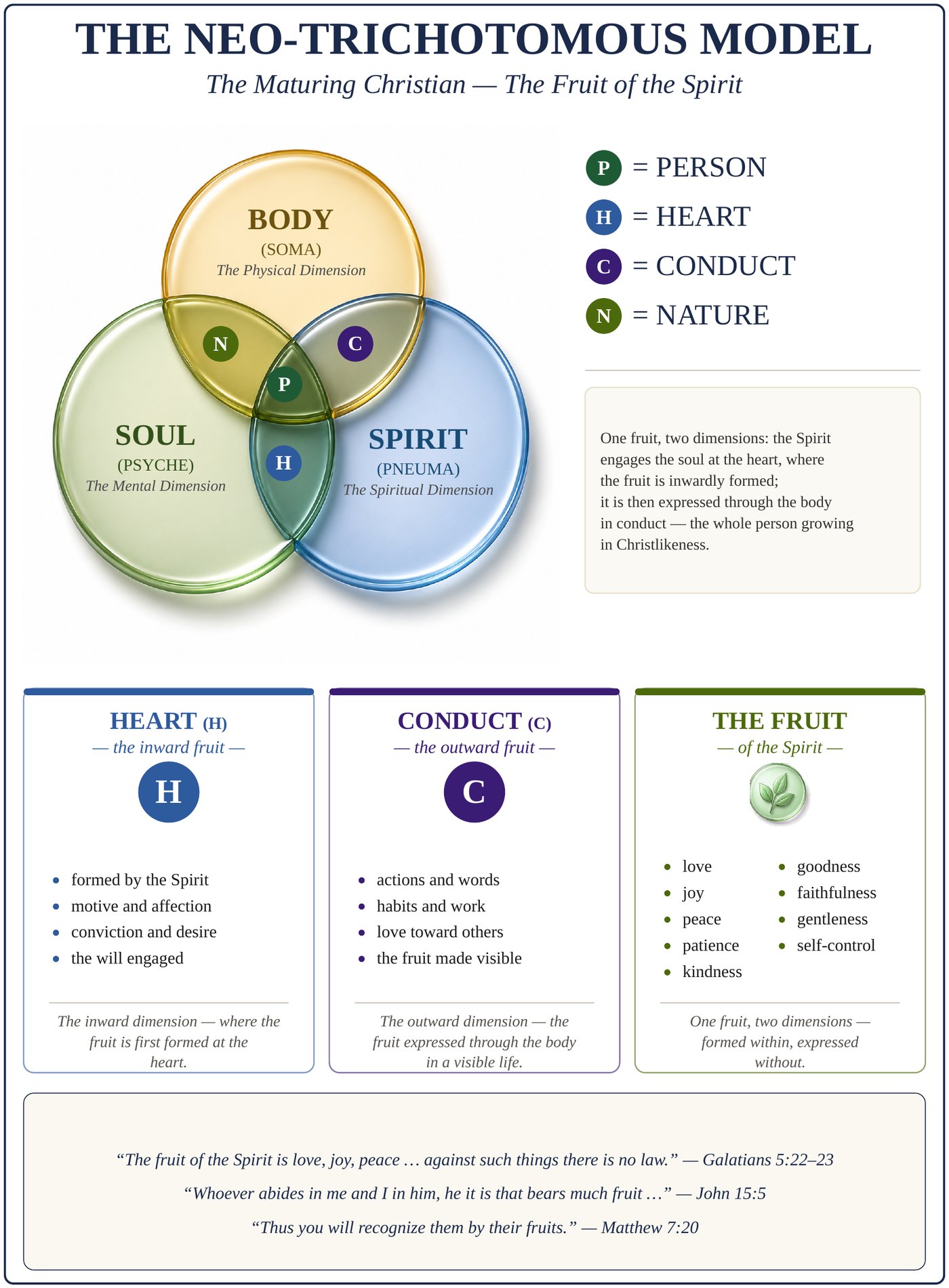
That framework runs beneath this whole essay.
The Church’s public convictions are not formed in a vacuum. They arise from what we love, what we believe, what we fear, what we desire, and what we understand ourselves to be. Those inward realities are then expressed through our bodies, our speech, our institutions, our politics, our relationships, and our treatment of other people.
In other words, doctrine does not remain in the mind.
It becomes conduct.
As a career program/project manager, I've learned that even the most carefully developed objectives mean little unless they produce the outcomes they were intended to achieve.
We can develop a sound concept, defend its logic, and persuade others of its value. But eventually, we must examine what the program actually accomplishes.
Christian doctrine deserves a similar examination—not merely whether our beliefs are biblically and historically sound, but whether our understanding of those beliefs is transforming the way we live.
We can formulate beliefs, defend their historical foundations, and explain their biblical authority. But what happens when those beliefs encounter another human being?
What kind of person do they help form? Do we see patience, courage, humility, and love? Or do we see contempt, suspicion, fear, and the desire to dominate?
If our understanding of God's love never becomes visible in our conduct, something has failed between design and delivery.
This is why the relationship between heart, nature, and conduct matters to the Church’s public witness. If our hearts are disordered, our understanding of truth may be bent toward self-protection or cultural loyalty. If our understanding of human nature is incomplete, we may reduce people to their behavior, their political identity, or their perceived usefulness to our cause. If our conduct is detached from love, our convictions may become technically religious while functionally opposed to the character of Christ.
Redemption and sanctification are therefore not merely abstract theological concepts. They shape the whole person. What God accomplishes spiritually is received, interpreted, and expressed through the body and soul, influencing what we love, what we believe, how we respond, and how we act.
The movement is not from doctrine directly to public argument.
It is from spiritual reality, through the transformed person, into embodied conduct.
That is the work of discipleship.
And it is precisely what is missing when Christians possess strong positions without mature formation.
This model is not offered as a final answer to every theological question. It is a proposed framework for helping us discuss the relationship between Christian doctrine, human nature, redemption, sanctification, and faithful practice.
A faith we understand is a faith we can explain. And a faith we can explain thoughtfully is a faith we can examine honestly—especially when our conduct fails to resemble the Christ we claim to follow.
We should be able to disagree vigorously about doctrine while remaining united in the love of Christ.
Indeed, that may be one of the most important demonstrations of Christian maturity.
Unity does not require intellectual uniformity.
And love does not require us to abandon the search for truth.
Ten Thousand Arguments, One Commission
I am not suggesting that Christians should withdraw from public life.
We have responsibilities as citizens, neighbors, parents, advocates, and members of communities that extend far beyond the walls of our churches.
Justice matters. Human suffering matters. Public policy matters. The protection of vulnerable people matters.
Some issues demand courageous Christian engagement.
Others, frankly, occupy far more of our religious attention than their relationship to the teachings of Jesus would seem to justify.
The problem is not that we have opinions about ten thousand issues.
It is that we sometimes lack a coherent Christian worldview through which to understand them.
Without such a worldview, the Gospel becomes a collection of positions rather than a transforming encounter with the living Christ.
And the Great Commission becomes obscured by the Great Arguments.
At the close of Matthew’s Gospel, the risen Jesus commissions His disciples to make disciples of all nations. He commands them to baptize those disciples and to teach them “to observe all that I have commanded you” (Matthew 28:18–20). The commission therefore joins evangelism, incorporation into the community of faith, and sustained obedience to Jesus’ teaching. It is not merely a mandate to secure agreement; it is a call to form people whose lives are shaped by Christ.
Jesus did not commission His followers to win every cultural dispute.
He commanded them to make disciples.
To baptize.
To teach.
To share the life and teachings He had entrusted to them.
And when He spoke about how His disciples would be recognized, He did not point to their political influence, theological vocabulary, or ability to defeat an opponent in debate.
On the night before His crucifixion, Jesus gave His disciples a “new commandment”: “Just as I have loved you, you also are to love one another.” He then explained the public consequence of that command: “By this all people will know that you are my disciples, if you have love for one another” (John 13:34–35). Their love was not an optional ornament added to discipleship; it was to be the visible mark by which the world recognized their allegiance to Him.
He pointed to their love for one another.
That should trouble us.
Not because Christian conviction is unimportant, but because conviction without love can become a contradiction of the very Gospel it seeks to protect.
What Would Paul Write to Us?
I sometimes wonder what an apostolic letter to the Church in America would sound like today.
Would Paul congratulate us for our political victories?
Would he admire the sophistication of our technology, the reach of our media ministries, our beautiful facilities, our newly paved parking lots, or the size of our congregations?
Perhaps he would recognize some genuine accomplishments. But I suspect he would also ask difficult questions:
Have we taught our children why we believe?
Have we equipped our congregations to distinguish biblical conviction from cultural preference?
Have we nurtured mature disciples, or merely recruited supporters?
Have we made room for honest theological inquiry, or have we confused questioning with disloyalty?
And have we demonstrated the love of Christ toward those who seem least deserving of it?
Paul’s letters to the Thessalonians offer an instructive example. In his first letter, he commends the believers because their “work of faith,” “labor of love,” and “steadfastness of hope” have become known beyond their local community (1 Thessalonians 1:2–8). Yet his encouragement is not detached from instruction: he continues to teach them how to live, urges them to grow in holiness and mutual love, and calls them to encourage and build one another up (1 Thessalonians 4:1–12; 5:11). In his second letter, he likewise prays that the Lord will direct their hearts “to the love of God and to the steadfastness of Christ” (2 Thessalonians 3:5).
Paul’s example shows that Christian maturity is neither passive tolerance nor mere doctrinal correctness. It is faith expressed through love, strengthened by teaching, and made visible in persevering obedience.
That is what discipleship looks like.
Not an absence of correction, but correction within a relationship shaped by love.
Not an abandonment of doctrine, but doctrine that produces spiritual maturity.
Not a Church without convictions, but a Church whose convictions emerge from its knowledge of God and are expressed through a transformed human life.
The Road Back Is Still Open
I do not believe the Church is beyond renewal.
Nor do I believe we must abandon its institutions, traditions, or theological inheritance to recover what matters most.
We need not invent another Gospel.
We need to understand and live the one we’ve been given.
That Gospel is simple. Paul handed it on “as of first importance”: “that Christ died for our sins in accordance with the Scriptures, that he was buried, that he was raised on the third day in accordance with the Scriptures” (1 Corinthians 15:3–4).
That is our message. Every doctrine we teach and every conviction we defend should be able to trace its way back to it.
Simple, but not shallow.
Consider turning on the kitchen faucet. A child can do it, and clean water arrives when it is needed. Yet behind that simple act stands a source, a treatment plant, miles of engineered infrastructure, a distribution system reaching our street, and the plumbing within our walls.
We don’t need to understand that entire system to enjoy a glass of water.
But understanding how it was designed, built, and delivered gives us something more than the ability to receive its benefits. It equips us to explain it, sustain it, and pass that knowledge along to the generations that follow.
The Gospel is the water. Historical doctrine helps us understand what God has revealed about its source and purpose. Discipleship teaches us to live by what we’ve received—and to share both the gift and our understanding of it with others.
The message remains simple. Our responsibility to understand it, live it, and pass it along is considerably more demanding.
Living it means taking discipleship seriously again—not as an introductory course before someone becomes a church member, but as the lifelong formation of people learning to think, love, and live as followers of Jesus.
It means teaching Christians not only what to believe, but how belief becomes character.
It means asking not only whether a conviction sounds biblical, but what kind of person that conviction is forming.
It means encouraging questions without surrendering truth.
It means allowing theological disagreements without turning fellow believers into enemies.
It means remembering that every person we encounter, including the most egregious sinner, remains someone God loves.
And it means refusing to confuse the defense of our own positions with the advancement of God’s Kingdom.
Perhaps the Church’s greatest challenge is not that the world has become too hostile to Christianity.
Perhaps it is that we have become so accustomed to fighting for Christianity that we’ve neglected the more demanding work of living it.
The road back does not begin with winning another argument.
It begins with remembering whom we follow—and allowing His work to move from the heart, through the whole person, into the way we treat the world.
We can have ten thousand convictions.
But if they do not lead us toward the love of Christ, we may discover that we’ve traveled a very long way in the wrong direction.
And the greatest of these is love.
I write on theology, faith, philosophy, and public life at Warnock Commons (https://warnockcommons.org/). My theological papers and essays explore the relationship between Christian belief, human nature, and the responsibilities of living faithfully in a changing world.
Broadside No. 3 · published 16 October 2026 · licence and permissions
© 2026 Greg Warnock. Licensed under Creative Commons Attribution–NoDerivatives 4.0 International (CC BY-ND 4.0).
Scripture quotations are from the ESV® Bible (The Holy Bible, English Standard Version®), copyright © 2001 by Crossway, a publishing ministry of Good News Publishers. Used by permission. All rights reserved.
Reply, or request permission to reprint: permissions@warnockcommons.org