
The Papers
Jesus Is Fully Human and Fully God
Here is how — and why it does not mean a second God
Greg Warnock · 2026 · 24 pages · three figures · written for those asked about Jesus by Muslim friends
1.1 MB · 24 pages · fourteen sections, three model plates, and a glossary of key terms in English and Arabic. Opens in your reader; save it from there.
A note on the Arabic: the Arabic and Qur’anic terms here follow common transliteration and are offered as a starting point for conversation, not as a substitute for a native reader’s ear. Have them checked by a fluent speaker before the paper is printed or circulated in an Arabic-speaking setting.
Proposition
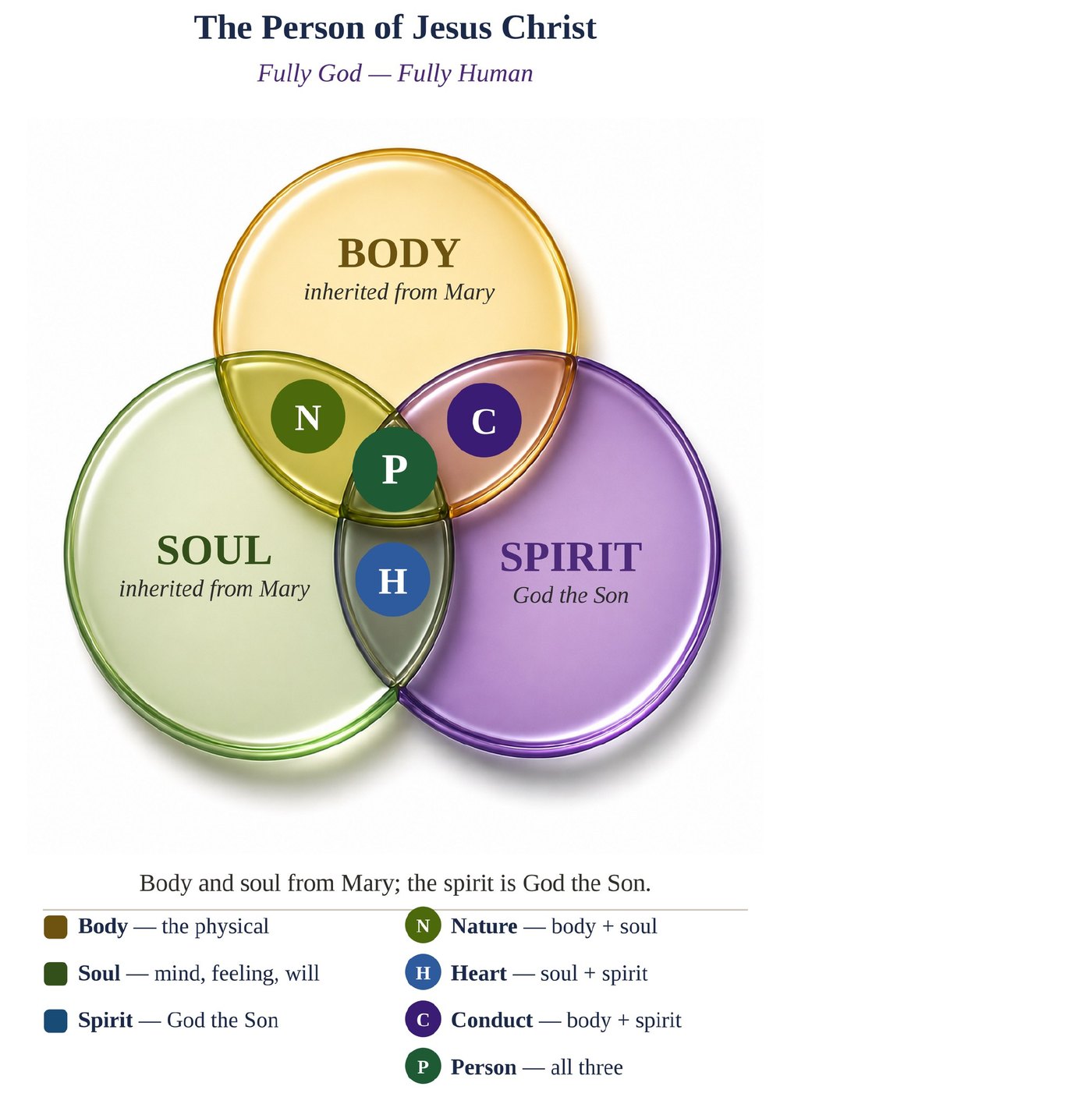
In every human being who has ever lived, the spirit is created — the created image of God, and the seat of moral volition and intuition. In Jesus of Nazareth alone, the spirit is uncreated: God Himself, eternal, never brought into being. That uncreated Spirit was united, at the moment of the virginal conception, to a body and soul derived entirely from Mary and from the covenant line of David and Abraham.
He is therefore fully God and fully man, in one undivided person. And because nothing was added to God in the Incarnation, the confession of Christ’s deity introduces no second god beside the One.
Summary
Our Muslim friend usually puts two questions to you at once — how can Jesus be God, and how is that not shirk. Both are asked across a foundation the two of you already share: that God is one. The Christian answer is not that a second God exists, but that the God they both confess took a human body and soul to Himself — and saying that early changes the conversation. Behind both lies a prior question about what a human being is, and neither can be answered until we have said plainly what a person is made of.
Both traditions describe the human being in three terms — body, self, and a God-given spirit. Both hold that this spirit is created by God, not a fragment of God’s own being. That agreement is broad, and it should be established before anything is contested.
From there, two points of disagreement remain.
First: is that created spirit corrupted? Islam holds that the rūh remains untouched and the fiṭra is pure, damaged only from outside — and that God pardons whom He wills, directly, needing no mediator. This model holds that sin resides in the spirit itself, in the moral faculty God created, so that pardon forgives the debt without repairing the instrument. The necessity of a divine Savior follows from this and from nothing else.
Second: is there one exception to the createdness of the human spirit? We say there is exactly one. In Him, body and soul were created — which is how He could be born and how He could die — while the Spirit was eternal God, which is why death could not hold Him.
Stated this way, the charge of shirk dissolves without recourse to a single analogy. We are not adding a partner to God. We are saying God took to Himself a human body and a human soul. Two monotheists, disagreeing about the nature of the one God — which is a conversation, where an accusation of polytheism is not.
There is a third difference, treated at the end of section 10. It is not an argument but an observation, and in practice it moves more people than either point above: in Islam, love is something God has and grants to those who qualify. Scripture says God is love, and proved it toward those who had not qualified and could not.
A note to the reader
The person asking you this question is usually not looking for a debate. He is watching to see whether you will handle the oneness of God carelessly. Answer slowly, and answer with respect for what he already believes, because a great deal of it is true.
Nothing in this paper requires you to tell your friend he is foolish. It requires you to show him where, precisely, the two of you part company — and to be honest that the parting is narrow and deep rather than wide and shallow.
Contents
- 1.The Question, As It Is Actually Asked
- 2.The Model, in Brief — and Why It Holds
- 3.Where We Already Agree
- 4.The Human Spirit Is Created
- 5.The One Exception
- 6.Created and Begotten
- 7.The Virginal Conception
- 8.One God — Where We Both Begin
- 9.A Word About the Word “Son”
- 10.Why the Savior Must Be Uncreated in Spirit
- 11.And Why He Must Also Be Created as Man
- 12.The Incarnation Does Not End
- 13.On What Remains Hidden
- 14.What Makes a Christian a Christian
- Closing · Glossary of Key Terms
Figures
- 1.The human person as created — Adam
- 2.One person, and the part that changes — the spirit through its three states: created, severed, restored
- 3.The Incarnation
Jesus Is Fully Human and Fully God: Here Is How — and Why It Does Not Mean a Second God · 2026 · about 10,200 words · a companion paper to Understanding the Nature of Humanity · licence and permissions
© 2026 Greg Warnock. Licensed under Creative Commons Attribution–NoDerivatives 4.0 International (CC BY-ND 4.0). You may copy, print and redistribute it in any medium, for any purpose, provided you give credit and do not distribute modified material.
Translation into any language is permitted under a separate standing grant. Current terms and the signed grant.
Reprint enquiries: permissions@warnockcommons.org